
Mountain biking takes you to wild places. Sometimes, you need to carry your mountain bike—up stairs, over rivers, through dense woods, or for transport. But carrying a mountain bike is not as easy as picking up a small object. Mountain bikes are heavy, bulky, and awkward to hold.
If you do it wrong, you can hurt yourself, damage your bike, or waste energy.
Many riders struggle with this. Maybe you have tried to carry your bike and felt the pain in your arms, or nearly dropped it. Or, you needed to load your bike into a car, but didn’t know the best way.
If you learn how to carry a mountain bike correctly, you save time, avoid injuries, and keep your bike safe.
This guide will show you practical ways to carry a mountain bike in different situations. You will learn step-by-step methods, tips for safe lifting, common mistakes, and solutions for transport. The advice is clear, simple, and backed by real-world experience.
By the end, you will feel confident handling your bike anywhere.
Understanding Mountain Bike Weight And Design
Mountain bikes are made for rough terrain, so they are built strong. Most mountain bikes weigh between 25 and 35 pounds (11–16 kg). Some downhill bikes can be heavier, up to 40 pounds (18 kg), while lightweight cross-country bikes may be closer to 20 pounds (9 kg).
The frame is usually made of aluminum, carbon fiber, or steel. Each material affects weight and balance. Aluminum is common and light, carbon fiber is lighter but more expensive, steel is strong but heavy.
The shape of mountain bikes makes them hard to carry. The frame is big and has angles, the handlebars stick out, and the wheels are large. The pedals and gears can poke your legs or clothes. These things make it important to use a proper carrying method.
Frame Types And Carrying Challenges
Most mountain bikes have a triangle frame. Some have suspension in the back (full-suspension), which adds weight and changes the balance. Hardtail bikes (only front suspension) are usually lighter.
If your bike has a dropper seatpost, it can lower the seat for easier carrying. Wide handlebars can hit doors or walls. Fat tires make the bike heavier.
Knowing your bike’s weight, frame material, and features helps you choose the right way to carry it.
Essential Safety Tips Before Carrying
Before picking up your mountain bike, think about safety. Lifting a heavy bike can cause injury if you are not careful.
- Check your surroundings: Make sure the ground is flat and not slippery. Watch for obstacles, pets, or people.
- Use proper lifting technique: Bend your knees, keep your back straight, and use your legs to lift. Do not twist your spine.
- Grip securely: Hold the bike with both hands. Avoid grabbing sharp parts or cables.
- Watch for moving parts: Pedals, wheels, and handlebars can move. Secure them if possible.
- Protect your body: Wear gloves if you have them. Avoid carrying near exposed gears or chainrings.
- Lift within your strength: If the bike is too heavy, ask for help. Do not force it.
Many beginners try to lift the bike by the handlebars or seat only. This can cause the bike to swing and hit them. Always lift from strong points on the frame.
Carrying Methods For Short Distances
When you need to carry your mountain bike a short way—like up stairs, over a log, or through a narrow path—use a method that suits your strength and the situation.
1. The Top Tube Carry
This is the most common method for short distances.
- Stand beside the bike.
- Grip the top tube (the horizontal bar) with one hand.
- Lift the bike so the rear wheel leaves the ground.
- Hold the handlebars with your other hand to balance.
This method works well for bikes with a straight top tube. You can walk and lift at the same time. It’s fast and easy, but your arm may get tired if the bike is heavy.
2. The Shoulder Carry
Useful for stairs, steep hills, or rocky ground.
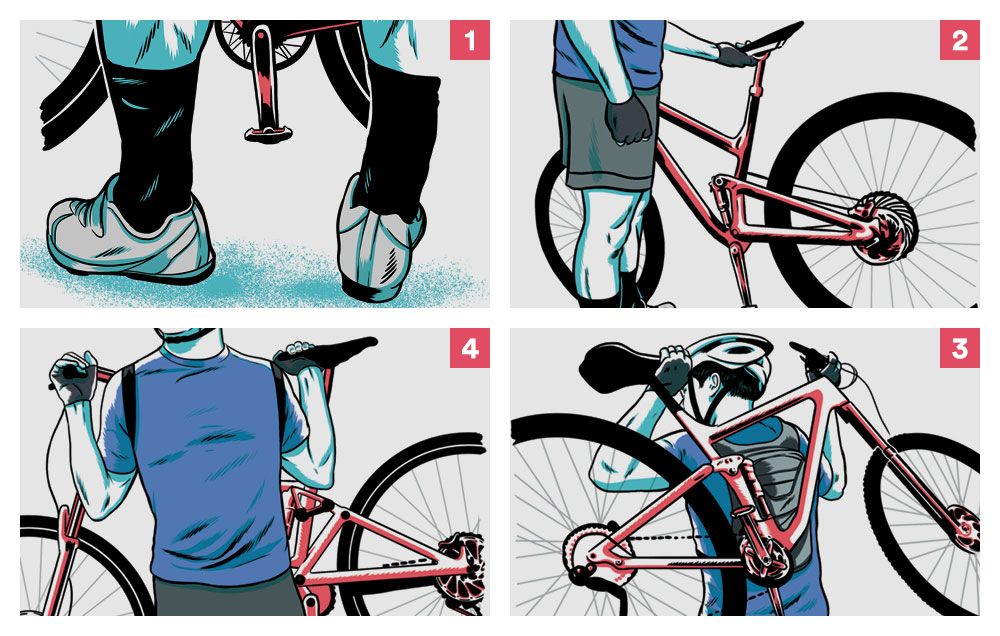
- Stand beside the bike.
- Rotate the bike so the top tube rests on your shoulder.
- Hold the handlebars to keep the bike stable.
- Use your free hand to balance or hold the seat.
This method keeps your hands free, and your body takes most of the weight. Be careful of pedals or gears hitting your body.
3. The Down Tube Carry
Some bikes have a sloping top tube. If so, use the down tube (the diagonal bar).
- Grip the down tube with both hands.
- Lift the bike so both wheels are off the ground.
This is less common, but works for bikes with sloped frames.
4. The Wheel Lift
If you only need to lift one wheel (for curbs or steps):
- Hold the handlebars and lift the front wheel.
- Use your foot to push the rear wheel up.
This saves energy and avoids full lifting.
Practical Example
Imagine you need to carry your mountain bike up five stairs. The shoulder carry is best. Place the top tube on your shoulder, hold the handlebars, and walk up. If you use the top tube carry, your arm may get tired before you reach the top.
Carrying Methods For Long Distances
Sometimes, you must carry your mountain bike for a longer distance—like hiking with your bike, crossing a river, or walking through a long hallway.
1. Full Shoulder Carry
This is similar to the shoulder carry, but for longer distances:
- Place the top tube on your shoulder.
- Hold the handlebars tightly.
- Use your other hand to grip the seat or balance.
To avoid fatigue, switch shoulders every few minutes.
2. Backpack Carry
If you have a bike carrying strap (sold in stores), attach it to the frame. Carry the bike on your back like a backpack. This spreads the weight and leaves your hands free.
Some riders use homemade straps, but official straps are safer.
3. Two-person Carry
If the bike is very heavy, or you are tired, ask a friend to help.
- One person lifts the front wheel and handlebars.
- The other lifts the rear wheel and seat.
- Walk together, keeping the bike level.
This method avoids injury and works for big bikes.
Real-life Data
In a survey of mountain bikers, 72% said they prefer the shoulder carry for long walks, but 18% use carrying straps. Only 10% ask for help with extra-heavy bikes.
Non-obvious Insight
Switching shoulders is important. Many beginners carry on one side only, which leads to muscle pain. Alternate shoulders every 5–10 minutes.
Carrying Through Obstacles: Rivers, Rocks, And Dense Bush
Mountain biking often means crossing tough terrain. Carrying your bike through rivers, over rocks, or through thick bush needs special care.
Crossing A River
- Remove any loose items (water bottles, bags) before crossing.
- Use the shoulder carry to keep the bike above water.
- Step carefully. Rivers can be slippery.
- If the river is deep, carry the bike on your back using a strap.
Climbing Rocks
- Use the two-person carry if the rocks are high.
- For small rocks, use the top tube carry and balance with the handlebars.
Dense Bush
- Hold the bike by the down tube or seat tube.
- Keep the bike close to your body to avoid branches.
- Move slowly and watch for sharp objects.
Practical Advice
Many riders damage their bikes in rivers by letting the wheels dip into water. Always keep the drivetrain (gears, chain) dry if possible. Wet gears can cause rust and poor shifting.
Carrying Up And Down Stairs
Stairs are a common challenge for mountain bikers. Whether at home, in a parking garage, or on a trail, stairs require careful technique.
Carrying Up Stairs
- Use the shoulder carry for steep or long stairs.
- Hold the handlebars steady.
- Walk slowly and watch your step.
- If the stairs are short, use the top tube carry.
Carrying Down Stairs
- Use the top tube carry for more control.
- Keep the bike away from your legs.
- Step down carefully. Bikes can swing and hit you.
Data Table: Carrying Methods For Stairs
Here’s a comparison of carrying methods for stairs:
| Method | Best For | Comfort | Control |
|---|---|---|---|
| Shoulder Carry | Up stairs | High | Medium |
| Top Tube Carry | Down stairs | Medium | High |
| Two-Person Carry | Heavy bikes | High | High |
Carrying For Transport: Cars, Public Transit, And Storage
Carrying your mountain bike for transport is different from carrying it on a trail. You need to avoid damage, dirt, and scratches.
Carrying Into A Car
- Remove the front wheel (and sometimes the rear wheel) to make the bike smaller.
- Hold the frame by the down tube or seat tube.
- Place the bike gently into the trunk or back seat.
- Cover sharp parts to protect the car interior.
Many cars can fit a mountain bike if you remove both wheels. SUVs and vans are easier.
Carrying On Public Transit
- Use the top tube carry to move quickly.
- Hold the bike upright. Avoid blocking doors.
- If the bus or train has a bike rack, use it.
Some cities have strict rules for bikes on transit. Check local laws before riding.
Carrying Into Storage
- Use the shoulder carry to move up stairs or into a garage.
- Hang the bike on a wall hook if possible.
Comparison Table: Bike Transport Options
Here’s a look at transport choices:
| Transport Method | Ease of Carry | Bike Protection | Space Needed |
|---|---|---|---|
| Car Trunk | Medium | High | Large |
| Public Transit | Easy | Medium | Small |
| Storage Room | Easy | High | Medium |
Non-obvious Insight
Always remove loose items before carrying the bike into a car or on transit. Water bottles, pumps, and bags can fall and cause damage.
Carrying For Travel: Flights And Shipping
If you need to fly with your mountain bike or ship it long distance, carrying and packing is more complex.
Preparing The Bike
- Clean the bike to remove dirt and mud.
- Remove the wheels, pedals, and sometimes the handlebars.
- Pack the bike in a bike travel bag or box.
Most airlines require bikes to be packed in a box or bag. Shipping companies may have special rules.
Carrying To The Airport Or Shipping Center
- Use the top tube carry or carry the packed box with both hands.
- Ask for help if the box is heavy.
- Use a cart or trolley for long distances.
Packing Tips
- Protect the frame with foam or bubble wrap.
- Cover the gears and chain.
- Label the box with your name and address.
Data Table: Packing For Air Travel
A comparison of packing methods:
| Packing Method | Protection | Ease of Carry | Cost |
|---|---|---|---|
| Bike Travel Bag | High | Medium | High |
| Cardboard Box | Medium | Medium | Low |
| Hard Case | Very High | Hard | Very High |
Common Mistakes
Many beginners forget to protect the derailleur (gear part) or leave air in the tires. Airlines may ask you to deflate tires, so check rules before packing.
Carrying For Bikepacking And Racing
Bikepacking means traveling long distances with your mountain bike, often with gear attached. Racing often requires quick carrying over obstacles.
Bikepacking Carry
- Attach bags to the frame, seat, and handlebars.
- Use the shoulder carry for obstacles.
- Remove bags before crossing rivers.
Some bikepacking bags make the bike heavier. Plan ahead.
Racing Carry
- Practice quick shoulder carry for races.
- Learn to lift and run with the bike.
- Keep your bike light if possible.
Professional racers practice carrying their bikes to save time during competitions.
Common Mistakes And How To Avoid Them
Many riders make mistakes when carrying their mountain bike. Here are some to avoid:
- Lifting with your back: Always use your legs to lift.
- Holding by weak parts: Never lift by cables, brake levers, or derailleur.
- Swinging the bike: Keep the bike steady to avoid hitting yourself.
- Forgetting loose items: Remove bottles, pumps, and bags before carrying.
- Not checking weight: If your bike is too heavy, ask for help or remove wheels.
Experience-based Tip
Some riders carry their bike by the seat only. This can bend the seat or damage the seatpost. Always use the frame.
Credit: www.bicycling.com
Tools And Accessories For Easier Carrying
There are tools and accessories that help you carry your mountain bike.
- Bike carrying straps: Attach to the frame for easy shoulder carry.
- Wheel covers: Protect wheels during transport.
- Foam frame protectors: Prevent scratches when carrying.
- Bike travel bags: For flights or long trips.
- Wall hooks: For storage at home.
Many stores sell these accessories. They are worth the investment if you carry your bike often.
How To Carry Different Mountain Bikes
Not all mountain bikes are the same. Here’s how to carry common types:
Hardtail Mountain Bikes
- Usually lighter.
- Use top tube carry or shoulder carry.
Full-suspension Bikes
- Heavier and harder to balance.
- Use shoulder carry and switch sides often.
Fat Bikes
- Very heavy with wide tires.
- Use two-person carry or strap carry.
Kids’ Mountain Bikes
- Light and small.
- Use top tube carry.
How To Carry A Mountain Bike With Injuries
If you have an injury (back, shoulder, arm), carrying a bike is risky.
- Ask for help.
- Use a carrying strap to spread weight.
- Avoid stairs or rough terrain.
- If possible, roll the bike instead of lifting.
Many riders try to carry their bike with one hand when injured. This can worsen injuries.
How To Carry A Mountain Bike For Cleaning And Maintenance
When cleaning or fixing your bike, you need to move it around.
- Use the top tube carry for short moves.
- Place the bike on a work stand for cleaning.
- Avoid holding by the wheels or gears.
Environmental Impact: Carrying And Bike Care
Carrying your mountain bike carefully protects both the bike and nature. Dropping your bike can damage the frame or pollute rivers with grease.
- Always keep your bike away from water sources.
- Avoid dragging the bike on sensitive ground.
- Use proper carrying to reduce environmental harm.
Training And Practice For Better Carrying
Carrying a mountain bike is a skill. Practice makes it easier.
- Start with short distances and light bikes.
- Practice the shoulder carry and switching sides.
- Try different methods to find what works for you.
Professional riders train to carry their bikes quickly and safely.
Advanced Tips For Experienced Riders
If you ride often, learn advanced techniques.
- Practice quick lifts for races.
- Use carrying straps for long hikes.
- Learn to remove wheels fast for transport.
Some riders use custom frame pads to protect their shoulders.
When Not To Carry: Rolling Alternatives
Sometimes, you don’t need to carry your bike. If the ground is smooth, roll the bike instead.
- Push the bike by the handlebars.
- Use both hands for balance.
- If the path is rough, carry only when needed.
Many riders waste energy by carrying when rolling is possible.

Credit: www.mountainbikeworldwide.com
Carrying A Mountain Bike With Other Gear
If you have a backpack, helmet, or other gear, plan ahead.
- Use the shoulder carry to keep hands free.
- Remove heavy items from the bike before carrying.
- Balance your load to avoid falls.
Bikepacking requires careful planning for gear and carrying.
How To Teach Children To Carry Their Mountain Bike
Children often struggle to carry their bike.
- Teach them the top tube carry first.
- Help them lift with their legs.
- Supervise and assist with heavy bikes.
Children should not carry bikes up long stairs or rough terrain.
Carrying A Mountain Bike In Groups
When riding with friends, carrying bikes together can help.
- Use the two-person carry for heavy bikes.
- Share tips and help each other.
- Plan stops for carrying in tough terrain.
Group rides are safer and easier when carrying bikes.
Frequently Asked Questions
How Heavy Is A Typical Mountain Bike?
Most mountain bikes weigh 25–35 pounds (11–16 kg). Downhill bikes can be up to 40 pounds (18 kg), while lightweight models are around 20 pounds (9 kg). Weight depends on frame material, size, and features.
What Is The Safest Way To Carry A Mountain Bike Up Stairs?
The shoulder carry is safest. Place the top tube on your shoulder, hold the handlebars, and walk slowly. For short stairs, the top tube carry works well. Always use your legs to lift, not your back.
Can I Carry My Mountain Bike Alone If It’s Very Heavy?
If your bike is too heavy, use a two-person carry. One person lifts the front wheel and handlebars, the other lifts the rear wheel and seat. For solo carrying, remove wheels to reduce weight or use a carrying strap.
How Do I Prepare My Mountain Bike For Air Travel?
Clean the bike, remove wheels and pedals, and pack it in a bike travel bag or box. Protect the frame with foam, cover gears, and label the box. Check airline rules for tire deflation and packing requirements. For more details, see the official airline bike policies at Wikipedia.
Are There Accessories To Help Carry My Mountain Bike?
Yes, you can buy bike carrying straps, wheel covers, frame protectors, and travel bags. These make carrying safer and easier, especially for long distances or travel.
Carrying a mountain bike is an important skill for every rider. With proper technique, the right tools, and safe habits, you can handle your bike anywhere—from trails to airports. Practice, stay safe, and enjoy the ride.

Credit: www.youtube.com

Hello Guys! I am John Reese, a professional biker and my hobby is biking! I have been biking for last 12 years and I love using bikes while outing as well. Based on my experiences with the different type of bikes (mountain bikes, road bikes and hybrid bikes); I am sharing my opinion about various bikes so that a beginner can get started right away. Happy reading!